On 5 September, we marked World Spinal Cord Injury (SCI) Day 🎗️
In the lead-up to the day, Spinal Research Institute’s CEO Margaret Rozman and two of our Board Directors, Dr Mario D’Cruz and Professor Marc Ruitenberg, reflected on what this year’s milestone theme meant for our organisation.
Professor Ruitenberg, SRI Director, noted that maximising the impact of SCI research depends on researchers, clinicians and people with lived experience working together, and that the challenge ten years on was no longer awareness but bringing people together around shared priorities.
Dr D’Cruz, SRI Director and Ambassador, who has lived at the intersection of spinal injury and research as both a quadriplegic and a doctor of 25 years, reflected that spinal cord injury research was never merely academic, but translated into tangible improvements in the everyday life of people living with the condition.
Margaret Rozman, SRI CEO, said the organisation’s role was to turn research potential into progress by connecting people, strengthening collaboration, and ensuring lived experience shaped the research — with SRI’s 2026–2030 strategy focused on closing the gap between awareness and impact.
Over the past decade, awareness of spinal cord injury had grown substantially, with injuries increasingly recognised not just as life-changing but, in many cases, as preventable. But awareness alone wasn’t enough. As World SCI Day marked ten years of raising awareness, the Spinal Research Institute is also looking ahead: 2026 marks the start of our new strategy — details to follow — aimed at strengthening spinal cord injury research and accelerating real-world outcomes.
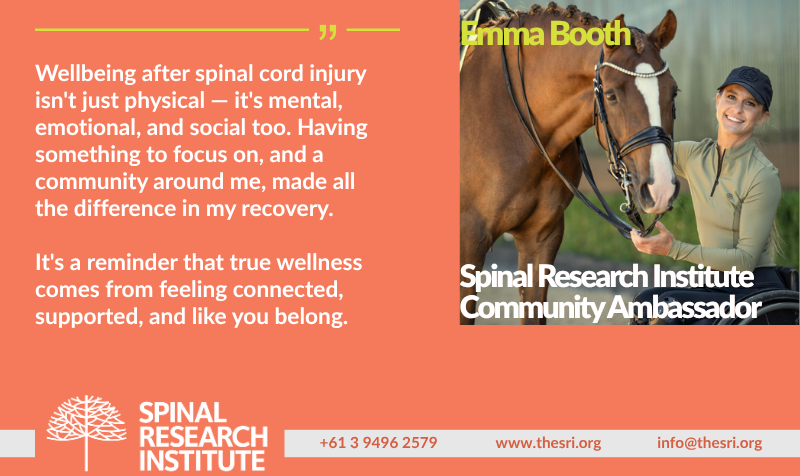
The Spinal Research Institute’s Community Ambassador, Emma Booth — Australian Paralympian and Para-Dressage rider — experienced firsthand how research and community can shape a person’s recovery and quality of life. Her story was recently featured in The House of Wellness, where she opened up about the daily realities of living with spinal cord injury and the role research plays in improving quality of life.
It was an experience that echoed her belief that quality of life after spinal cord injury isn’t one-size-fits-all — it’s different for everyone, and good research involves people living with spinal cord injuries to ensure the results are grounded in real life.
At the Spinal Research Institute, we support and fund research shaped by people like Emma, because we know that involving people with lived experience leads to better health outcomes.
Emma will be joining The House of Wellness Radio this November to talk more about life after spinal cord injury — from getting back in the saddle to why lived experience belongs at the heart of research. Stay tuned for details 🎙️
We’re grateful for the support of partners like Chemist Warehouse, who help make Spinal Research Institute’s work possible.
About World Spinal Cord Injury Day
World Spinal Cord Injury Day was launched in 2016 by the International Spinal Cord Society (ISCoS) to raise global awareness of the challenges faced by people living with spinal cord injury, and to promote prevention, treatment, and long-term inclusion. Marked annually on 5 September, this year’s observance carried particular significance, as ISCoS marked ten years of the campaign under the theme “From Awareness to Action: Ten Years Advancing SCI Prevention.”
Since its inception, the day has been recognised in dozens of countries, with each year’s theme spotlighting a different aspect of life with spinal cord injury — from access to services and rehabilitation, to the importance of lived experience in shaping research and care.
