
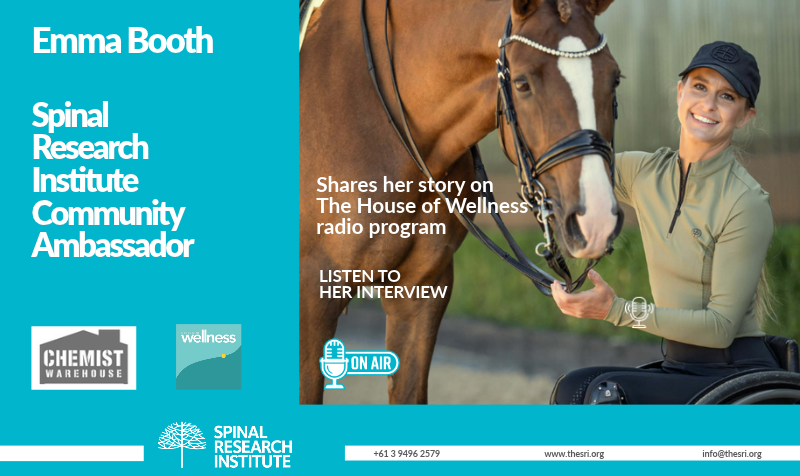
Our new Community Ambassador, para-equestrian athlete and Paralympian Emma Booth, joined Sarah Maree Cameron and Gerald Quigley on The House of Wellness to talk about her role with SRI. Emma has lived with a spinal cord injury for more than 13 years. In this 7-minute chat, she shares how getting back in the saddle just six months after her 2013 accident gave her a new sense of purpose. She also talks about the road to the Paralympics, life in Strathbogie, and why looking after both physical and mental health matters so much for people living with spinal cord injury.
Transcript: Emma Booth, Paralympian and SRI Community Ambassador
The House of Wellness (radio show)
Duration: 7 min 17 s
Hosts: Sarah Maree Cameron and Gerald Quigley.
Sarah: Now we get to welcome an incredible person to the show, the new Community Ambassador for the Spinal Research Institute, leading para-equestrian athlete Emma Booth. Thank you so much for joining us.
Emma: Oh, no worries. Thanks for having me.
Sarah: Can you tell us about your new role as Community Ambassador for the Spinal Research Institute?
Emma: Yeah, absolutely. First of all, I’m really grateful to be associated with such a terrific organisation that is doing some incredible work. In a very basic sense, the Spinal Research Institute enables and supports research that improves the health and wellness of people with spinal cord injuries. This is mainly done through connecting and supporting researchers, clinicians and people with spinal cord injuries, which is where I come in. I’ve been living in a wheelchair with a spinal cord injury for over 13 years now, and I’m hoping my lived experience and my perspective will help support the work of the Spinal Research Institute.
Sarah: Emma, such a beautiful story. Thank you so much for sharing. You live in gorgeous regional Victoria. Can you tell me a little about the impact horse riding has had on you and your community?
Emma: My partner and I moved to Strathbogie in April of last year. It’s considered the horse capital of Victoria, and given that my passion lies with horses and horse riding, it’s the perfect place for me to be. We’re absolutely loving it up here. The countryside’s beautiful, it’s a lovely part of the world, and we’ve met some really wonderful people. It’s a beautiful community. At this point you probably couldn’t pay me enough to leave. We love it.
Gerald: Emma, spinal cord injuries have a lot of associated secondary health implications. In your 13 years, have you found other things cropping up that wouldn’t necessarily worry someone without a spinal cord injury, but that you’re aware might happen over the years because of your injury?
Emma: Definitely. Everybody living with a spinal cord injury has different experiences, but ultimately there are always things on a day-to-day basis that can change and that you have to monitor and regulate. Looking after your physical self, but also your mental self, is really important, probably even more so for people living with spinal cord injuries. The impact it can have on a daily basis is quite significant, but when you’re looking after yourself to the best of your ability, and you have a lot of support behind you, that’s what makes it more manageable. So organisations like the Spinal Research Institute, and the work they’re doing, can really make a big difference to people living with a condition like this every day.
Gerald: That’s correct.
Sarah: Emma, we hear you have such a lovely passion for horse riding. You were a two-time Paralympian / para champion and more recently you attended the World Para Championships in Germany. Wow, that’s incredible in itself. Can you explain how the mental side of riding has helped with your recovery? I’ve heard some wonderful stories about equine therapy.
Emma: For sure. I was in a car accident in 2013, and I had ridden horses all my life before that. I think it was only about two weeks after my accident that I set myself the goal of getting back in the saddle. I think at that point I even told my mum and dad that I was going to go to the Paralympics in Rio.
Sarah: Oh, I love that.
Emma: At that point it was a bit of a dream goal, but I did have amazing support from friends, family and a wider community that really helped guide my journey to the Paralympics. I was fortunate that six months after my accident I was back in the saddle, and probably another six months after that I was campaigning for the Paralympics in Rio.
For me, being able to get back in the saddle and do something… Prior to my accident I was so active. I was only 21 at the time. Then being in hospital for six months, only in a wheelchair or a bed and quite physically limited, having that freedom of getting back in the saddle and feeling the horse moving underneath me gave my life a new sense of purpose and meaning. I think it really shaped my life with a spinal cord injury. It kept me motivated and positive, and physical activity plays a lot into that, but it also leads to your mental health. I don’t know what my journey would have looked like if I hadn’t had that in my life, to be honest.
Gerald: Fair enough. Emma, a technical question: what type of horse do you find easiest to bond and work with? Is it thoroughbreds? Where do you start?
Emma: Oh, that’s a good one. As a competitor I’ve mainly worked with warmbloods. They tend to be a breed that’s quite successful in the dressage scene, which is what I do. However, I’ve also worked with off-the-track thoroughbreds and found they’re a really great breed to work with, because they’re super adaptable and willing. I’ve worked with a lot of different breeds, but those are probably two of my favourites.
Sarah: I love that, and that’s a great question. I’ve just written both of those names down. I’ve been on some horse rides, not often, certainly not often enough, so you’ve inspired me to go and try to find somewhere to go horse riding again, because it’s been a long time since I did that. I’m just so glad it’s given you that purpose again. Thank you so much for joining us.
Emma: Not at all. If you ever want to get back in the saddle, you’re welcome to come up to Strathbogie. I’ve got plenty of horses up here, and the dogs.
Sarah: You may regret offering that to me, I’m just going to say. Emma Booth, para-equestrian athlete and Community Ambassador for the Spinal Research Institute. You can find out more online at thesri.org.
